
Real-World Examples
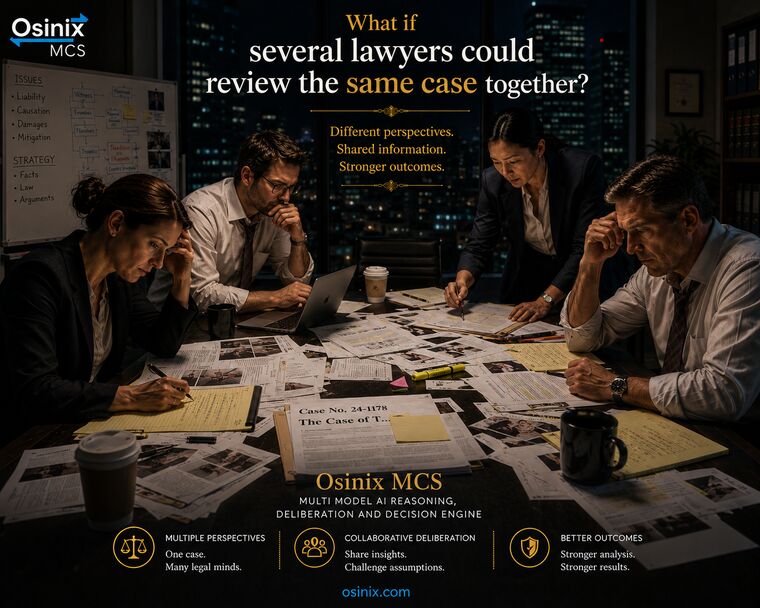
The earlier articles explained the idea behind MCS. This one shows what it looks like on real problems. Each example below is drawn from a demonstration that ships with MCS, and each shows a different shape of deliberation. You can run them yourself.
A Legal Strategy Decision
A wrongful-termination case is heading to mediation. The question is simple to ask and hard to answer: litigate or settle?
Instead of asking one model, MCS puts a panel on the actual case brief. Two associates take opposing mandates: one builds the case to litigate, the other builds the case to settle. Each cites specific facts from the brief and presses the weak points in the other's argument. A senior-partner moderator follows each round, weighs the exchange, and writes a final strategy memo: the recommended path, the strongest argument against it, and why one outweighs the other.
What you get is not "the AI says settle." It is a reasoned recommendation with the opposing case already on the table, ready to hand to a partner.
A Code Review That Uses Judgment
A function compiles cleanly. No warnings, even under strict compiler flags. It still contains a real defect that will surface at run time.
MCS runs it as a review. One model hunts aggressively for problems. A second challenges each finding: is this a genuine bug, or noise that would waste the team's time? A lead moderator forces every disputed point to a concrete failure scenario, then sorts the results into what must be fixed, what is worth considering, and what is fine as written.
What you get is the difference between a tool that flags everything and a review that can say "this looks wrong, but it is correct, and here is why." That is judgment, not just detection.
An Estimate You Can Trust
Some questions have no clean answer: effort, cost, risk. Ask one model and you get a confident number you have no way to check.
With MCS, each model makes its estimate without seeing the others. Only after that independent reasoning do the models compare assumptions and challenge one another, then revise. No model is anchored by what another said first. The moderator weighs the reasoning, not just the numbers, and lands a final estimate with the disagreements left visible.
What you get is more than a number. You see where the models agreed, where they did not, and which assumptions were shaky. The spread between honest, independent estimates is itself a signal of how solid the answer is, something a single model can never give you.
The Common Thread
Three different domains, one discipline. In each, more than one perspective is forced to engage, and a moderator directs the discussion to a conclusion you can defend. That is the pattern behind every MCS session, whatever the subject.
The Bottom Line
These are not edge cases dreamed up for a brochure. They are the kind of work MCS was built for: high-stakes, easy to get wrong, and expensive to get wrong quietly.
When the answer matters, MCS shows its work.
Want to learn more about MCS?