
Mixing Different AI Models
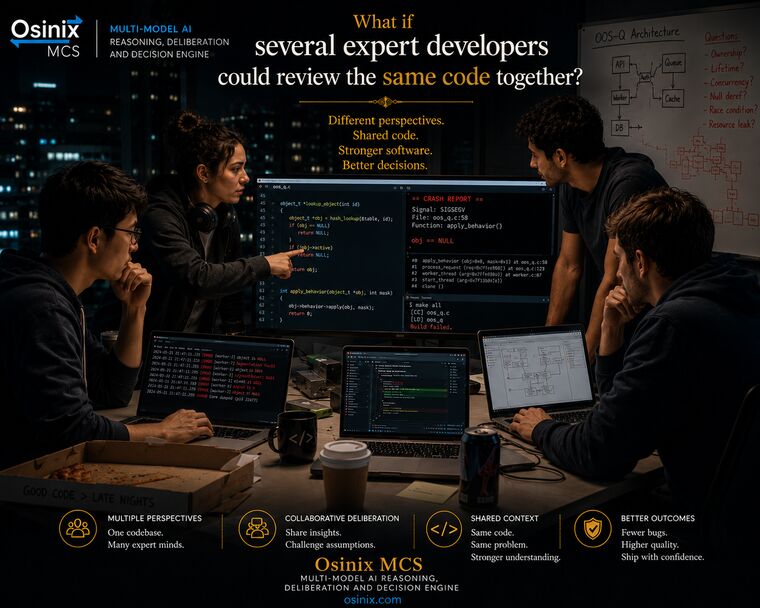
A good team is not one person repeated. Neither is an MCS panel.
Most AI tools ask you to pick a model and live with its trade-offs. MCS asks a better question: why pick one, when the strengths of several can work together on the same problem?
No Model Is Best at Everything
Every model has a shape. Some reason carefully but slowly. Some are fast but shallow. Some are tuned for code, others for a specific professional or technical domain. Some do not work in text at all; they generate images, audio, or video.
Picking a single model means accepting its weaknesses along with its strengths. Mixing models means you do not have to.
A Panel of Specialists
In MCS, a panel can be built from different kinds of models, chosen to complement each other. You decide which models participate; MCS does not dictate the panel.
A careful reasoning model can sit beside a fast coding model and check its logic. A domain specialist can correct a general-purpose model that strayed outside what it knows. A small local model can handle routine work at no API cost while a frontier cloud model takes on the hardest reasoning. Each one does what it is best at, and the others catch what it misses.
The point is not redundancy. It is coverage. Four copies of the same model tend to share the same blind spots. A carefully chosen panel is more likely to expose them.
Guiding a Fast Model With a Careful One
One of the most useful pairings is a strong reasoner working with a quick, lightweight model. The fast model drafts; the reasoner pressure-tests it, catches the leaps, and tightens the result. You keep much of the speed of the small model while benefiting from the larger model's review, because the careful model is in the room to challenge the quick one.
When Models Create, Not Just Decide
Mixing models is not limited to text and decisions. A panel can include models that produce images, audio, or video, and they can hand real work to each other.
Picture two image models collaborating. The first paints a scene and passes the actual file to the second, which paints over it in its own style. A third model reviews the combined result and comments on what worked. That is not three separate pictures compared side by side. It is a genuine collaboration, with real artifacts moving between models, guided by the same structured discussion MCS uses for any other problem.
Strengths Add Up, Weaknesses Get Caught
This is the whole idea in one line. When you mix models well, their strengths combine and their individual weak spots get caught by someone else in the room.
You are not searching for the one perfect model. You are assembling the right team for the question in front of you.
The Bottom Line
The future of serious AI work is not a single all-knowing model. It is the right models, working together, each contributing its best and checking the others.
MCS is built for exactly that.
Want to learn more about MCS?