
Introducing MCS Engine
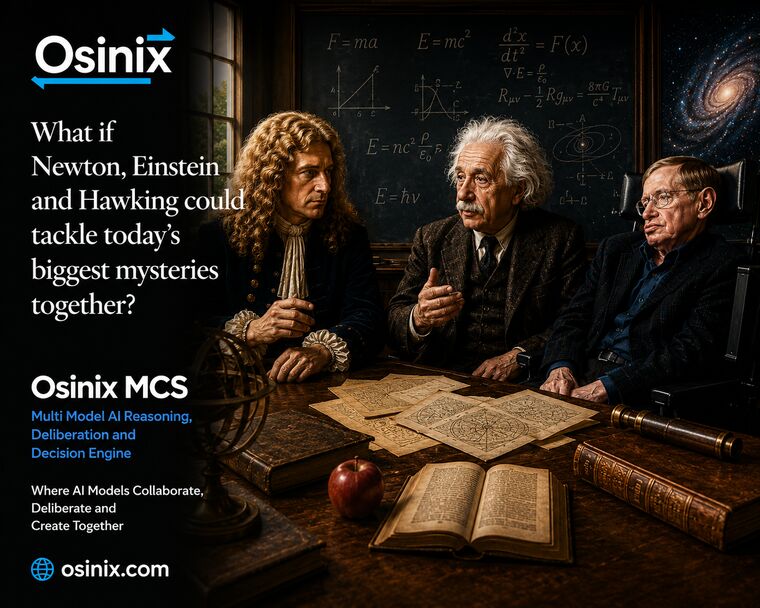
One model gives you one answer. MCS gives you an answer that has been argued, challenged, and defended.
The Problem
AI is now used to make decisions, not just to chat. People ask a model what to do, and they act on what it says.
But a single model gives you a single opinion. It can hallucinate. It can latch onto the first idea and never reconsider it. Worst of all, it states a guess and a near-certainty in the exact same confident voice, so you cannot tell which is which.
When the stakes are low, that is fine. When being wrong is expensive, it is a liability. And asking the same model twice rarely helps. The second answer carries the same training and the same blind spots as the first.
A Different Approach
MCS is not a bigger model. That is more of the same.
MCS is not a second opinion from the same model. That is the same bias, twice.
MCS is not majority voting. That counts votes; it does not test reasoning.
MCS is structured deliberation.
It puts several AI models on a panel and has them work the problem together under a moderator. They propose, challenge each other, defend their reasoning, and revise. The moderator keeps the discussion focused, evaluates the exchange, and drives it to a conclusion. What you get back is not one model's reflex. It is a position that survived scrutiny.
What Makes MCS Different
| One Model | MCS |
|---|---|
| One opinion | A panel that challenges each other |
| Confidence you cannot verify | Reasoning you can inspect |
| First answer wins | The answer that survives scrutiny |
| One model's blind spots | Blind spots caught by other models |
| Ask again, get the same bias | Disagreement surfaced, not hidden |
| Locked to one provider | Any models you choose, together |
Combine Different Kinds of Models
A panel does not have to be the same model repeated. Put a strong reasoning model next to a fast coding model, a domain specialist, and a broad generalist. Pair a careful reasoner with a model that is quick but shallow, and let the reasoner check its work. Specialized models that generate images, audio, video, code, or domain-specific analysis can participate too, so a panel can reason about and create more than text.
Each model contributes what it does best, and the others check it. That mix is the point: the strengths add up and the weak spots get caught.
Built for Decisions That Matter
MCS is for the moments where a wrong answer costs real money, time, or trust.
Bring your own models, wherever they run. All cloud, all local, or a mix. Keep the whole panel on your own hardware for privacy and without cloud API charges, or pair a local model with a frontier cloud model. MCS works with major cloud providers such as OpenAI, Anthropic, and Google, with aggregators like OpenRouter, and with self-hosted local models like Ollama, llama.cpp, LM Studio, and vLLM. No lock-in.
Two ways to run a panel. Let the models deliberate as equals in a roundtable, or run a directed session that follows a clear order. Choose the shape that fits the question.
An answer you can stand behind. MCS gives you a conclusion that was tested, so you can show your work to a colleague, a client, or a regulator.
Who MCS Is For
MCS is for teams who cannot afford a confident wrong answer.
- Engineering reviews where a missed flaw ships to production.
- Legal analysis where one reading of the facts is not enough.
- Medical research where accuracy is not negotiable.
- Financial risk assessment where a wrong call is expensive to undo.
Anywhere "the model said so" is not a good enough reason.
The Bottom Line
MCS is not selling you more models. It is selling challenged, defensible answers for the moments when being wrong is expensive.
One model gives you an opinion. MCS gives you a conclusion that has been challenged.
Want to learn more about MCS?