
How MCS Thinks
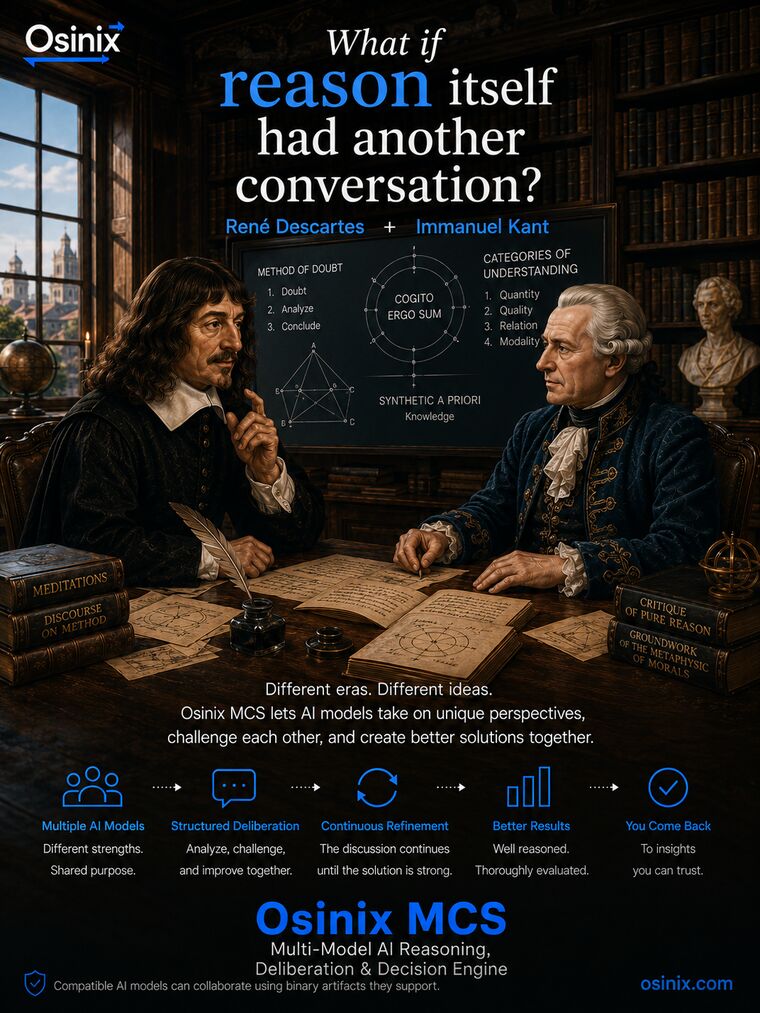
Most AI works the same way: you ask a question, one model answers, and that answer is the result. MCS works differently. It does not take the first answer. It tests it.
Instead of relying on a single model, MCS runs a structured discussion among several AI models. Each brings its own strengths and perspective to the problem, and the panel examines an answer before it becomes the result.
A Structured Deliberation
A session follows a clear pattern. One model proposes an approach. The others analyze it: they point out weaknesses, offer alternatives, or support the parts they agree with. The discussion continues until the panel has worked through the important trade-offs.
Depending on the question, the panel can debate in turns, work independently and then compare notes, or follow a directed order. Whichever shape it takes, a moderator keeps the discussion focused, asks for clarification when needed, and guides the panel to a conclusion.
The goal is not to make the models agree. The goal is to reach the strongest answer after it has been tested.
Different Models, Different Strengths
Every model has strengths and weaknesses. Some reason carefully. Some write code quickly. Some know a particular professional or technical domain better than others. Some generate images or other media.
MCS lets these capabilities work together instead of forcing you to pick one. A reasoning model can challenge a coding model. A specialist can correct a generalist. A local model can contribute alongside a frontier cloud model. The discussion that results is often stronger than any single participant.
Deliberation, Not Voting
Many multi-model systems just compare answers or count votes. MCS does neither.
If two models agree and one disagrees, the minority view is not thrown out. Sometimes that lone objection is the one that caught an assumption everyone else missed. Reasoning matters more than counting. The moderator weighs the discussion itself, not just the final tally.
Transparent Decisions
When a decision matters, the conclusion alone is rarely enough. People need to know why.
MCS preserves the reasoning, so a team can see how the conclusion was reached, what alternatives were considered, and why the final position won. That makes reviews more productive and important decisions easier to defend.
The Bottom Line
Good decisions are rarely the first opinion in the room. They come from discussion, criticism, revision, and evidence. MCS brings that process to AI.
Instead of asking one model to be right, it gives several models the chance to prove which answer deserves to be trusted.
Want to learn more about MCS?